
The Economics of Deception
The Canterbury TalesThis flow follows money as a medium of religious, legal, romantic, and scientific exploitation.
increasing Bearing strength in each event
 decreasing
Bearing strength in each eventdecreasingMerchant’s Credit

Merchant’s Credit
Public Confidence
The Merchant speaks proudly of trade routes and currency. His success depends on appearing solvent and authoritative.
Hidden Debt
The narrator knows that his borrowing is concealed. Economic identity is shown as a performance that may survive only while confidence lasts.
Summoner’s Bribe

Summoner’s Bribe
Law as Revenue
The Summoner threatens people with ecclesiastical penalties and accepts payment for relief. Legal language becomes a means of private enrichment.
The Purse as Punishment
His maxim that the purse is the Archdeacon’s hell reveals a cynical inversion of spiritual justice. Money replaces repentance.
Pardoner’s Collection
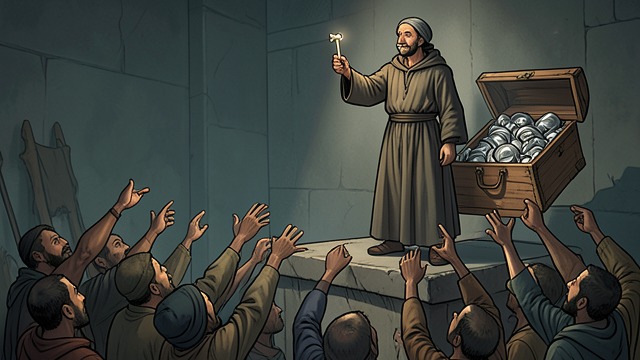
Pardoner’s Collection
Greed as Product
The Pardoner’s moral theme attracts offerings precisely because he presents himself as authorized to absolve. Spiritual anxiety becomes a commodity.
Fraudulent Distribution
He takes from the poor and keeps the proceeds. His economic method is transparent to himself even while hidden from his audience.
Aurelius’s Debt
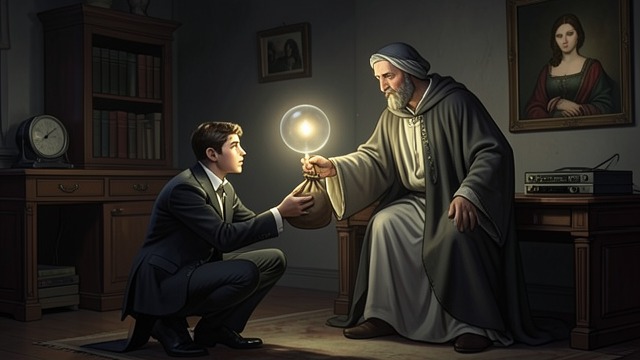
Aurelius’s Debt
Desire Bought on Credit
Aurelius promises a thousand pounds for the magical service. His love has already made him financially vulnerable.
Mercy and Insolvency
When Dorigen is released, Aurelius faces ruin, but The Magician forgives the debt. The tale redirects economic exchange toward ethical generosity.
Alchemy’s Empty Purse

Alchemy’s Empty Purse
Investment in Hope
The Canon’s Yeoman has borrowed and spent everything seeking transformation. Failure does not end the enterprise because hope continually promises a future success.
Systemic Scarcity
The tale connects private loss to a wider struggle among people and gold. Alchemy becomes an image of economic desire detached from evidence.
General Prologue
The Friar’s Tale
The Pardoner’s sermon performance
After The Magician removes the apparent rocks
The Canon’s Yeoman’s confession
